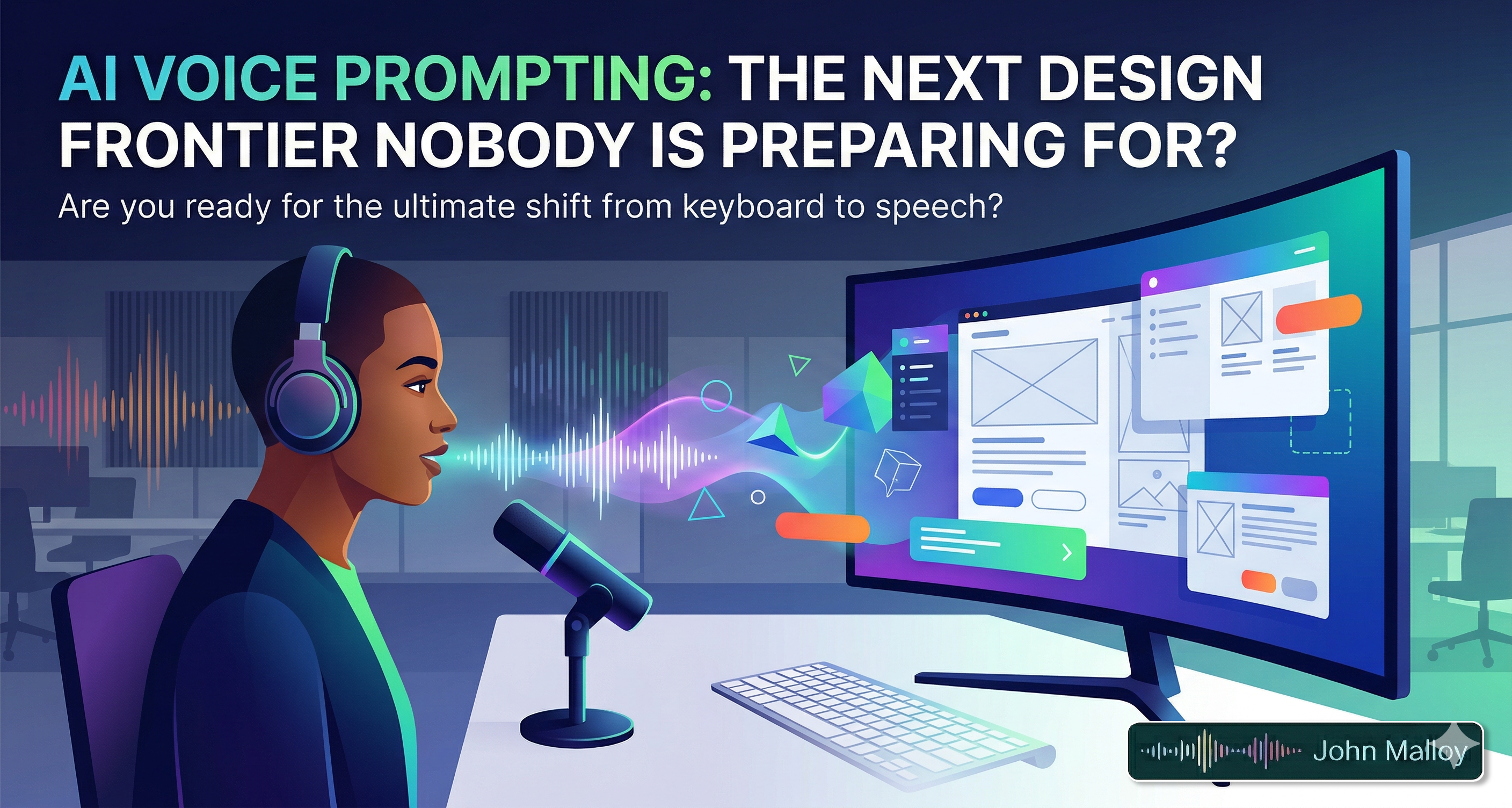
Here's my take: the next major shift in how designers work isn't going to come from a new Figma feature or a better AI plugin. It's going to come from designers putting down the keyboard entirely.
AI voice prompting is going to be the dominant creative interface for design work within the next three years. And almost nobody in the industry is thinking about what that actually means.
My prediction
The current AI design workflow still looks a lot like the old one. You open a tool, you type, you review, you iterate. The AI is faster and smarter, but the fundamental input hasn't changed. That's the part I think is about to break open.
AI voice prompting is the natural endpoint. Describing a layout, specifying component behavior, articulating a visual direction, all of that maps to speech more naturally than it maps to typing. When you can say "make the primary CTA more prominent, increase the contrast ratio, and show me three variations" and watch it happen in real time, the keyboard starts to feel like a detour.
I don't think this is five years away. I think it's closer to 6 to 18 months before early adopters are working this way, and a year or two before it's mainstream.
What this means for designers, and I'm being direct about this
The designers who thrive in this environment are going to be the ones who can think out loud with precision. Not just what something should look like, but why. What problem it solves. Who it's for. What it needs to communicate.
That's always been the mark of a great designer. AI voice prompting just makes it the primary skill instead of a secondary one.
I also think this reshapes what junior design work means. If execution becomes largely AI-driven, the entry point into this profession shifts hard toward judgment and critique. You can't prompt your way to good design without understanding what good design actually is. That foundational knowledge matters more in an AI voice prompting world, not less.
Here's the part I think the industry is completely unprepared for
Open floor plans are going to become a serious liability.
I'll say it plainly: the modern design studio, big tables, no walls, everyone visible, was designed around quiet, visual work. Keyboards and mice. The ambient hum of a creative office. It worked because making things was primarily an eyes-and-hands activity.
AI voice prompting blows that up entirely.
Imagine a studio floor where a dozen designers are simultaneously narrating prompts, giving verbal direction, and talking through iterations in real time. That's not a design studio anymore. It's chaos. And unlike the general noise of a busy office, this noise is cognitively disruptive in a specific way. Language competes with language. It's hard to think in words when someone nearby is also thinking in words, out loud.
I believe agencies and in-house teams that don't start thinking about this now are going to find themselves in a very awkward position, retrofitting their physical spaces at the same time they're trying to adapt to a workflow shift. That's a painful place to be.
What I'd do if I were planning a studio or office redesign right now
I'd treat acoustic separation as a core infrastructure requirement, not a perk. Pods, partitions, phone booth-style focus spaces, not for calls, but for daily creative work.
I'd reclassify quiet rooms as primary workspaces. They're going to be where the real work happens.
And honestly? I'd reconsider the assumption that in-office work has an inherent productivity advantage. A designer at home with a quiet room and no ambient language noise may simply be better positioned for AI voice prompting work than someone in a beautiful open studio.
The bottom line
AI voice prompting is coming whether studios are ready or not. The teams that treat it as an infrastructure question now, not just a tools question, are the ones that are going to come out ahead.
I could be wrong about the timeline. I don't think I'm wrong about the direction.