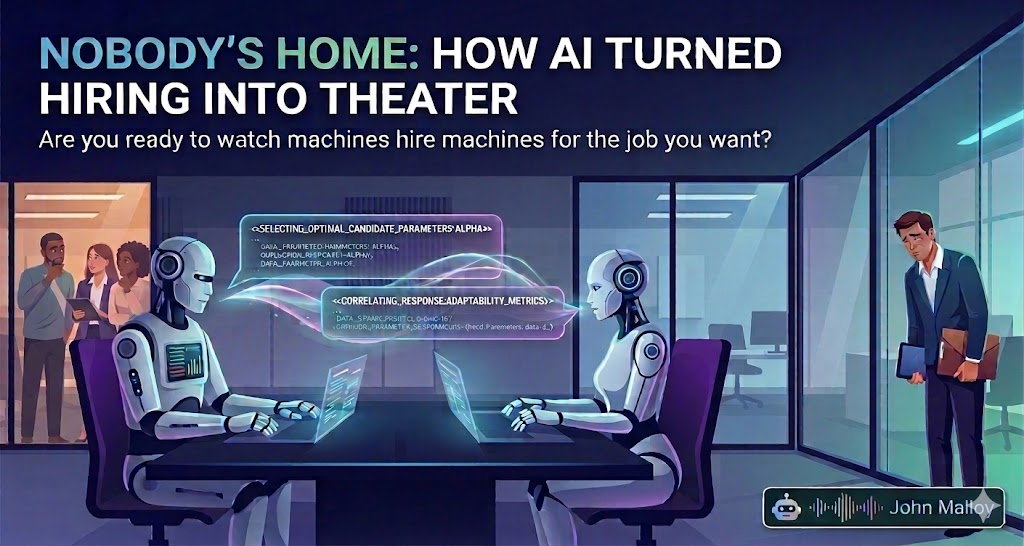
There's a phrase floating around job boards and LinkedIn threads that captures the current moment better than any HR report ever could: "It feels like I'm just trying to make my robots talk to their robots."
That one sentence says everything.
Somewhere in the last few years, hiring stopped being a conversation between two people trying to figure out if they'd work well together. Now it's a performance. Candidates perform for algorithms. Algorithms perform for hiring managers. Hiring managers perform for leadership. And at the end of the process, if anyone actually gets a job, everyone involved is left wondering: did we hire the right person, or did we just hire the person whose AI wrote the best prompts?
This isn't a minor inconvenience. The hiring system is broken in a way that's hurting both sides, and the frustrating part is that almost everyone can see it happening in real time.
The arms race nobody wanted
Here's how it started. Companies got flooded with applications. To manage the volume, they rolled out Applicant Tracking Systems that scan resumes for keywords and automatically filter out anyone who doesn't speak the algorithm's language. An experienced professional with 15 years in a field could get screened out because they wrote "oversaw" instead of "managed," or because their resume didn't include the exact phrase from the job description.
Candidates figured this out. So they started optimizing their resumes for ATS systems. Then they started using AI to write cover letters. Then AI to apply to dozens of jobs at once. Some are even using bots to auto-apply to hundreds of roles in a single click.
So companies responded by deploying more AI to filter the AI-generated applications. At some companies, a single job posting now draws over a thousand applicants in a 24-hour window. The answer to that problem? More automation. More filtering. More bots.
The result is a system where nobody is talking to anybody. Machines evaluate machine-generated documents, and real people sit at both ends wondering why nothing is working.
The interview that isn't one
The latest escalation is the AI interview. Candidates are now logging onto Zoom calls and being greeted not by a recruiter, but by a faceless bot with a synthetic voice, working its way through a scripted list of questions, unable to answer anything about the role or the company in return.
People are walking away mid-call.
One job seeker, after three months of searching, described clicking out of an AI interview in less than 10 minutes. Another, a technical writer with experience at Amazon and Electronic Arts, endured three separate AI interviews for different positions, each one lasting 25 minutes, each one incapable of having an actual conversation. He said he'd only consider doing more if he had a guarantee that a real person would eventually show up somewhere in the process.
That's the bar now. The guarantee that a human will eventually talk to you.
Some candidates are going further and refusing AI interviews outright, even while unemployed, reasoning that a company willing to automate the first conversation probably doesn't have a culture worth joining. One candidate put it directly: if the HR team can't spend 30 minutes talking to a candidate, what does that say about how the company values the people who work there?
What both sides are losing
Here's what makes this particularly painful: the problem is structural, not malicious. HR teams are genuinely overwhelmed. Hiring managers at some companies are expected to review hundreds of applications for a single role while maintaining a full workload. AI interviewers and ATS systems aren't being deployed because anyone thinks dehumanizing candidates is good strategy. They're being deployed because the math stopped working.
But efficiency isn't the same as effectiveness. And right now, the system is optimizing for processing volume while quietly destroying signal.
When resumes are AI-generated and filtered by AI, you're not selecting for the best candidate. You're selecting for the best prompt engineer. When interviews are conducted by bots, you're not evaluating cultural fit or communication skills or the kind of judgment that only shows up in a real conversation. You're evaluating how well someone performs for a machine.
For companies, this means real candidates fall through the cracks. For candidates, it means months of effort that feels like shouting into a void. Applications disappear. No response. No feedback. No signal at all. Just silence, and the quiet erosion of confidence that comes with it.
The thing that actually got lost
What's missing is something that can't be automated: the moment where two people figure out whether there's something real there.
Hiring has always been inefficient. It's always had bias and noise and inconsistency. None of that is new. But underneath all the friction, there was a human interaction at the center of it. Someone made a judgment call. Someone decided to take a chance on a person. Someone looked across a table, or a screen, and thought: yes, this person.
That judgment call is being automated away. And the irony is that neither side wanted it to go.
The solution isn't to retreat from technology entirely. AI tools have a place in hiring, and the volume problem is real. But there's a difference between using automation to assist human decisions and using it to replace human contact altogether. The companies that figure out where that line is will end up with better hires and candidates who actually want to work for them.
Right now, most companies haven't figured it out yet. And the people sitting at their desks refreshing their inboxes are paying the price.